ACTIVISM
Safeplace – My Story on Its Origins and Early Work
By Carolyn Byerly
Before there was Safeplace, there were the Rape Relief and the Women’s Shelter programs at the Olympia YWCA. Each had a paid coordinator, with the work of the programs carried on by trained volunteers. That work initially involved taking calls from women who had been battered or sexually assaulted to support them through the police reporting process, hospital exams, finding shelter (if needed), and accompanying them to court. In time, an educational component evolved as both groups were called on to speak to community groups about the problems we addressed. It was cutting edge feminist work, and our community was among the first in the US to establish these programs.
I became a Rape Relief volunteer around 1977 after being recruited by a couple of friends. As part of my training, I had to read Susan Brownmiller’s book Against Our Will, one of many life-changing events during my association with the group. I still had my full-time job with state government then, so I wasn’t able to go out on client calls that might come at all hours. In my early role, I helped write materials for educationals, as well as a grant application for a statewide conference on Rape Trauma Syndrome. The conference was a great success and I was finding my feminist identity growing stronger as I delved into the problems of sexual violence through our volunteers’ work and the stories of our clients. In a supportive network, I began to reevaluate my own life experiences, to find my voice on violence against women, and to work more directly with our clients.
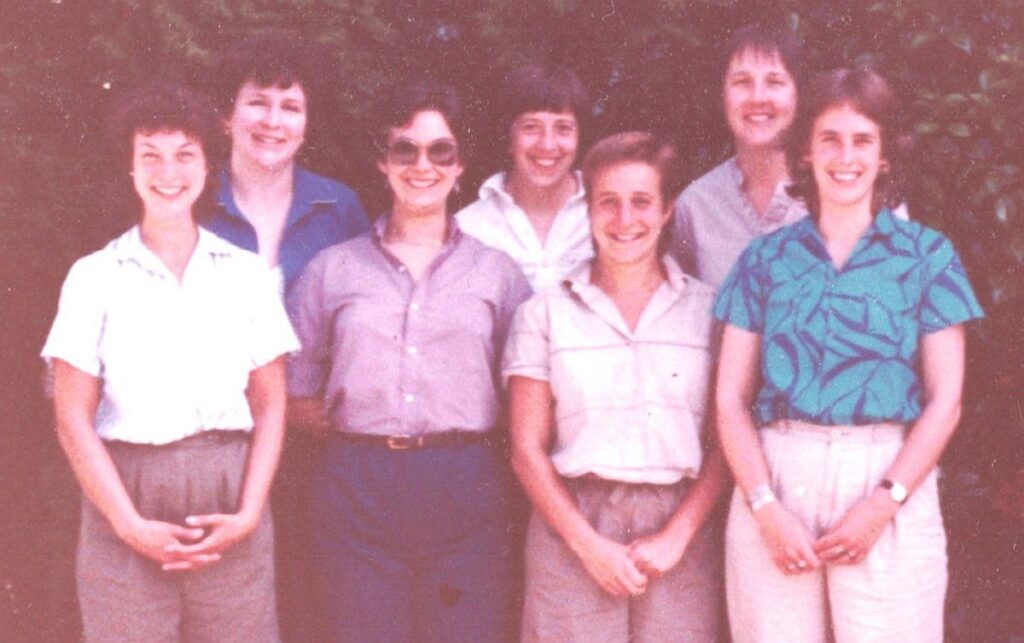
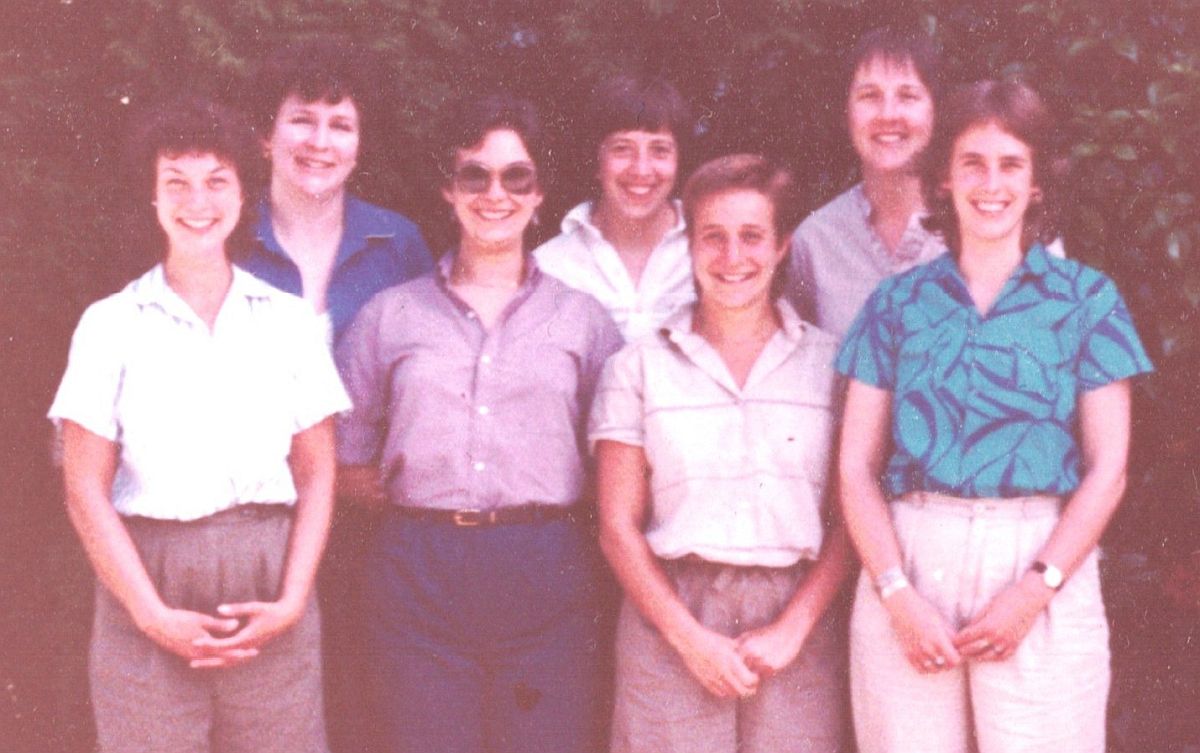
Back row L-R: Toni Holm, Peggy Pahl, Deborah Bancroft
I resigned my state job in early 1978 and assumed the half-time coordinator’s job at Rape Relief for the magnanimous salary of $500 a month. I supplemented it with another half-time job on the communications staff at The Evergreen State College. As the Rape Relief coordinator, I served as the liaison to the YWCA director, set up meetings for volunteer trainings and other events, and helped solicit funds for the program. As it would turn out, I also became the spokesperson for Rape Relief when the news media came calling—a familiar role since I had been a public information officer for a state agency and had experience working with reporters and had been a journalist before that. That meant I had met most of the local and state-level reporters, something that would be useful to both Rape Relief, and later Safeplace as it helped us move information about violence against women and our services into local news.
Those of us in Rape Relief had close connections with our sisters working in the Women’s Shelter program. Our program offices were housed in the basement and attic of the YWCA, respectively, but we spent informal time together in the kitchen over the coffee pot, and some of us were friends in everyday life. We began to talk more often about our client cases once we discovered that many battered women had also been sexual assault victims, and many of our clients in Rape Relief also were being battered or had come from violent homes. Violence against women was not easily categorized, but was a complex set of experiences, which, through second-wave feminist political action in the early 1970s, had been made criminal offenses nationally and in Washington State. Our volunteers provided clients with information about their options and emotional support and saw that they were fairly treated by the helping services and criminal justice system under these laws. We also provided public education on the problems and solutions.
Safeplace came into being once our two programs began to talk more actively about the logic of joining forces. We undertook the steps necessary to break from the YWCA and form a separate nonprofit organization. That transitional period was painful in many ways, the worst being that the YWCA board and staff took pride in having sponsored and nurtured our two programs for several years. They recognized the difference we were making in the community through our services and the stature this gave the YWCA.
Ethel Roesch, the YWCA director, was also a strong supporter of women’s advancement, and she eventually worked with us to make a smooth transition into Safeplace. That involved securing the portion of United Way and other agency funds that the YWCA had previously received for our programs, identifying members for a board, and securing a place to operate. The women’s shelter had been housing clients needing safety in a confidential location since its beginning. Now, as Safeplace, we considered bringing the shelter and our offices under one roof. We were working with a local real estate agent named Plum Stark who embraced our project and one day called us to say, “I have a perfect place for you—my house!” She was serious, and she soon moved from her large two-story house in the City of Olympia, and our staff began to move in. We put offices upstairs and clients in the downstairs rooms. We instituted systems of safety that included strict rules for clients around protecting the location of the facility.
Those of us who staffed Safeplace—both volunteers and paid staff—decided to operate as a women’s collective. We had several paid staff by then (including me, who was now the full-time administrator), but still relied on a large pool of trained volunteers to respond to calls. Most of us were in our 20s, and many were (or had recently been) Evergreen students. I was in my mid 30s and had come through a traditional college education and hierarchical professional life, so getting my mind around collective decision making was a challenge. It was also the range of work experience among our members that made it difficult for me—less experienced voices had the same weight as those of us with more, sometimes making for long meetings to resolve differences and make decisions.
There was also a great deal of emphasis on “working-class” consciousness and issues in the group, including “dressing down” (i.e., simply). I found myself not saying much on those issues, and years later, when I thought back, I reasoned I may have been the only one in many of those discussions who actually had a working-class family, as my coworkers seemed to come from professional families, and some had trust funds or an inheritance. It’s not that class issues were new to me—I had been initiated into radical politics and Marxist ideas years earlier through friends in the Socialist Worker Party—but I had not yet worked out how my own family history related. That would happen in subsequent years through therapy and in graduate school coursework.
As we figured out our new working relationships in Safeplace, we also saw a substantial increase in calls for assistance from local women and children. Some of the calls about children came from mothers after we did short presentations in local schools and their kids went home to disclose they had been abused. Our working relationships with local therapists expanded through these cases, as it did with state social services and local law enforcement agencies. At one point, staff at Child Protective Services asked us to pause school presentations because they didn’t have enough personnel to handle all the child molestation cases coming in. We responded by going to the legislature to lobby for more funding for CPS.
I had the good fortune to be at Rape Relief and Safeplace in years when feminists in our community and others were institutionalizing a radical new analysis of violence against women in public discourse and in the legal and criminal justice systems. Terms like sexual assault, domestic violence, wife battering, date rape, and sexual harassment did not exist before second-wave feminism emerged in the late 1960s. Then, women in consciousness-raising groups and small public speak-outs began to name their abuse experiences and develop a new framework of analysis that placed men’s sense of sexual entitlement and abuse central to gender inequality. With a new language around personal violence, feminists were able collectively to found rape crisis services and battered women’s shelters and to set about changing laws. National Organization for Women’s nationwide campaign to reform rape laws, beginning in 1972, inspired Washington state legislators to modernize our state’s laws, creating three degrees of rape, for example.
Feminist-led research aided the legal reforms. When Diana E. H. Russell published her federally funded study in the book Rape in Marriage in 1982, she provided the basis for us to tackle the historically accepted notion that men could force their wives to have sex. Agencies like Safeplace joined our counterpart organizations the next year in bringing Dr. Russell to Washington state for a series of public lectures and media interviews. We generated a rather nasty exchange in one legislative hearing on a bill to delete “marital exclusion” from Washington state law, with a state attorney’s association arguing against it, saying it would encourage women seeking a divorce to claim they were raped in order to get a better deal. It took a couple of years, and Seattle’s Charlotte Rayner and other reporters’ excellent coverage, to see the law eventually passed.
Our local data gathering also figured importantly into local institutional change. It came to our attention that some of the police agencies in Thurston County were hesitant to investigate sexual assault and domestic violence cases, and that prosecutors were slow or unwilling to prosecute them. We decided to call each of the major police departments each January to ask for data on these crimes, and we asked the county prosecuting attorney’s office to tell us how many cases they had taken to court the previous year. It was astounding, for example, that Tumwater police told us every year that they had had a few sexual assault reports, but they were all “unfounded,” what they called reports they believed had no basis—their annual number, therefore, was zero!
Safeplace then published a compilation of these data in a press release and sent it to all the local news organizations, which were quick to publish and broadcast it. Amazingly, things began to change quickly. The Thurston County Sheriff’s Department began to call us to do short presentations at deputies’ shift changes (some of them in the wee hours of morning), and one of the prosecuting attorneys set up a meeting with us to find out how to improve working with clients. Police across the board stopped telling rape jokes when we accompanied clients to report an assault.
Reporters at both the Daily Olympian (as it was then called), KGY radio and other outlets began to ask for interviews with our staff and clients. This prompted us to prepare “press packets” for local reporters with basic facts about sexual assault, working with victims and survivors, and some articles. We drew up a set of “victim rights with reporters,” and coached clients willing to meet with reporters to share what they wanted to of their stories. Before long, reporters had assumed the annual gathering of data from police and prosecutors, and they were calling us (particularly at Christmas time) about client services and stories. (P.S., I don’t believe these stories are being written these days in our community.)
By the mid-1980s, I was feeling a great deal of satisfaction in what I had contributed to Safeplace, and what Safeplace had established in the community. I knew that I was a small part of the whole story and that many others were working to carry on the work. Safeplace had stable funding, capable staff, and a solid presence in the community. My own restlessness to move on motivated my resignation in late 1983, and by the following year I was in graduate studies at the University of Washington, a decision that led me into a 40-year career in the academic field of media studies. Some of my academic research has addressed rape and battering in news, and I wrote a book that made it through three editions titled The Mother’s Book: How to Survive the Molestation of Your Child.
I remain forever grateful to the many sisters in struggle I knew and worked alongside in the Rape Relief/Safeplace organization over the years. To name a few: Leslie Owen, Jessica Schiffman, Carolyn Meyer, Carolyn Mark, Nancy Murphy, Claire Brown, Tyra Lindquist, Nancy Reid, Wanda Gayle, Becky Cubbage, Lori Faulkner Silverstone, Griselda Perretz-Rosales, Robin Brownstein, Peggy Pahl, Deborah Bancroft, Cheryl Henderson, Sutapa Basu, Karen Rodgers, Susan Eisele, Toni Holm, Jean (Janae) Reichert, Laurie (Lauren) Melville, Beth Harris, Carol Elwood, Kathy Pruitt, Linda Gabbert Keith, Earlyse Swift, Gene Liddell, Jan Bynum, and many others who will hopefully forgive my faulty memory for not naming them. Those years and you changed me forever.
We encourage readers to contact us with comments and corrections. Disclaimer