ACTIVISM
Olympia’s First Gay Rights Law
By Anna Schlecht
In 1986, Olympia was not the gay-friendly place we know today. At best, gay folks found little pockets where we felt safe in our jobs and homes and found acceptance. But there were no legal protections against discrimination.
During my first years in Olympia, I lived in one of those pockets. I lived in a house that was collectively owned by a couple of women, so we could not get evicted. Some of our neighbors thought being gay was against the law, and a few of them actually went down to City Hall to try to file a complaint. At the time, I had worked in couple of small businesses owned by gay women so we could not be fired. I was relatively safe, but few other gay people had the same protection against discrimination.
During an economic downturn in the early 1980s, work dried up for those of us who were small-time construction contractors. After a couple of years of gig work, I got hired in 1982 by the City to work in the Carpenters’ Shop. The culture shock was intense; it felt like I was stepping back in time. During my first week, two other public works employees were fired for union organizing. My immediate coworkers were good people; they just did not know anything about gay people except for the scary stereotypes they had heard. So, I very consciously went back into the closet because I needed the job; I was the breadwinner for my collective household, and I could not risk getting fired.
For about four years, that was my reality. My work life was entirely separate from the rest of my life. Then a couple of people decided it was time to stand up for gay rights.
One of the activists was Abby Haight; Abby grew up in Olympia. Her dad worked for the Olympia Brewery and at the time she worked as a reporter for the Olympian. Compared to other friends, she had an accurate read of the political landscape. We first met when she and another reporter co-wrote a series called “Gays in Olympia.” Abby also lived in one of those safe zones—her boss knew she was gay and her family accepted her. She was one of the visionary people who looked around at all the anti-gay backlash and decided she was not having it anymore.
“I knew Mayor Bill Daley,” said Abby, “and I remember a couple of long lunches when we talked about passing a gay rights law and how the community might respond. He was a good, supportive Democrat, and I think liked the idea of lifting this progressive, controversial idea into law. He liked the idea that a little town like Olympia could stand up for rights, just like San Francisco or Seattle. I also met with Mary Stuart Lux, a political dynamo who was a former state legislator and served on the City Council. She was supportive of the ordinance but warned us that many Olympians were not ready.”
Another activist who was part of this effort was Tom Howdeshell (1945-2007). Tom had worked for the state and lived as an openly gay man. A few years earlier, he had been harassed by local police for being gay. Before he died, he told me the story of having a uniformed police officer come into his office at the State and loudly confront him by calling him anti-gay slurs. This was a common tactic of anti-gay harassment at the time that often resulted in someone getting fired or leaving town in shame. I recall hearing the story when he fearlessly told the officer, “You can’t scare me, leave now.” When a group formed around the idea of getting a local gay rights law passed, Tom stepped up.
After a short series of meetings, the gay rights ordinance was drafted. Mayor Daley met with everyone else on the City Council to make sure they all supported it before he brought it forward for a public hearing and a vote.
Holly Gadbaw was on the Olympia City Council at the time and recalls the discussions about passing such an ordinance. Gadbaw was no stranger to community activism. As a member of the League of Women Voters, she was part of the effort to modernize Olympia’s governance from a three-person commission to the more democratic council-city manager model. Gadbaw knew that passing a gay rights law was the right thing to do but was surprised that not everyone in Olympia agreed.
“At first we considered passing a citywide law,” said Gadbaw. “But then Bill [Mayor Bill Daley] encouraged us to scale it down to just covering city services. I felt it should be citywide because I really did not think that giving people rights would be that controversial. Turns out I was wrong. I was surprised by how many opponents started coming to Council meetings to urge us not to pass it. Some of them actually came to our [the Council members’] homes after hours to pressure us. Apparently, one church put the names of all the Council members in their Sunday program to encourage their congregants to pray against this new law. But we all knew this was the right thing to do.”
Abby had invited me to join this effort in part because I was the only gay person she knew who worked for the City. Undoubtedly there were more, but the lack of legal rights made it dangerous to be out at work. At the time, passing such a law seemed too much to hope for, and I was nervous about getting fired. I was the breadwinner in my collective household, and I could not afford to get fired. Ultimately, the organizers decided that my public contribution to this effort would be to write a statement as an employee under an assumed name that would be read at the public hearing.
Finally, the night of the public hearing came. I knew it might get a little nasty when I saw a church bus pull up in the parking lot. The Council Chambers were filled, with many people standing in the back. And although it was hard to tell who was for or against gay rights, it seemed to be evenly split. I recall seeing one guy wearing a pastor’s collar who I assumed was anti-gay until a friend walked up and hugged him; this was the first time that I realized we did have some faith leaders on our side.
Abby recalled that knowing gay people often meant supporting their equal rights. “I have always believed that many anti-gay folks can be turned into friends if they learn that someone they love, like, or admire is gay. I think some of the city leaders were more favorable towards the ordinance because of their personal friends or workmates who took the risk of coming out to them, letting them know how important it was to have the protection of law.”
The public testimony went long with a steady stream of people walking up to the podium to declare themselves as for or against the new law. Supporters urged the Council to stand up for gay and lesbian rights, stating that discrimination was always wrong and equality was the face of the future. The opponents talked about how homosexuality was an abomination, some people actually said that AIDS was God’s revenge on gay people. My boss was in the audience, waiting for his agenda item to come up in staff reports and it was awkward because I had no idea how he would react—he was a very conservative Christian Republican. Members of his church were there protesting. Later he told me that people in his church would pray for him to fire me. (He did not.)
Abby remembered the testimony. “The Olympians who came down to City Hall to shoot down the ordinance were not friendly. Many were conservative Christians. Most brought their own interpretations of the Bible. Some threw out the usual vile and hateful cliches that had toughened all our skins growing up gay. But we had people who spoke with passion and honesty in support of our equal rights.”
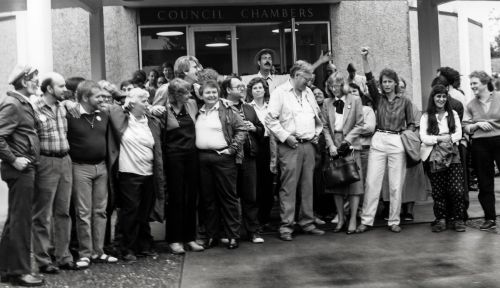
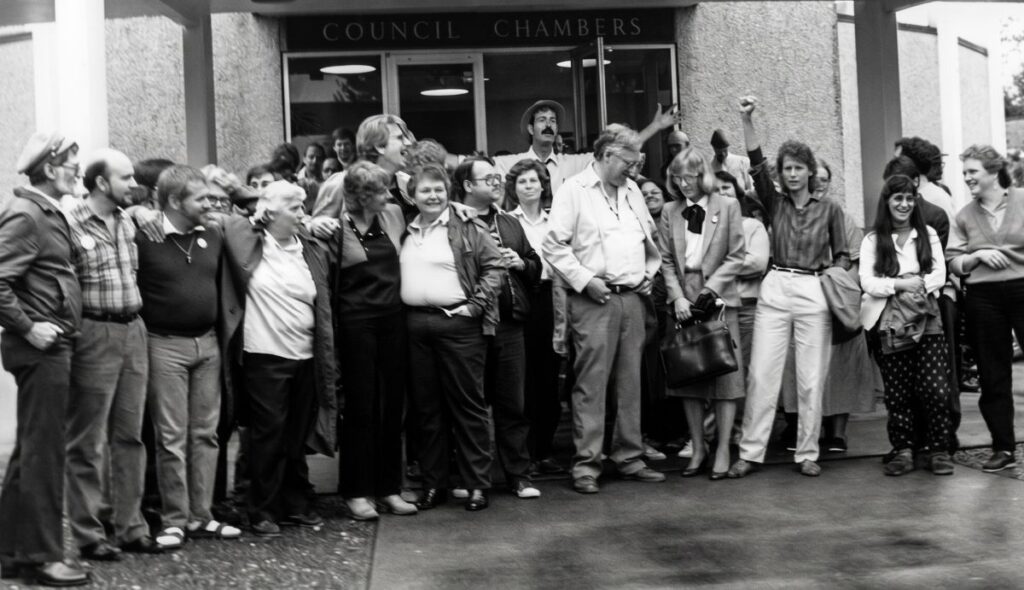
Once the public hearing was over it was time for the City Council to deliberate. It was nerve wracking to wait through the Council’s discussion. Then came the unanimous vote and the law passed. All the supporters erupted into cheers and Mayor Daley gave us a few moments of celebration before he gaveled the meeting back to order. Then everyone filed out of the Council Chambers, with both sides finding themselves awkwardly together on the same sidewalk. Paul Cienfuegos, a supporter and photographer, captured the spirit of hope in an iconic photo.
We did not know at the time what a watershed moment this was; Olympia had become the first small town in Washington to pass a gay rights law, 13 years after Seattle passed their 1973 law. The 1986 law was strengthened the very next year by expanding the law to include protections for transgender folks. This launched a slow process of passing what are now called LGBTQ rights laws, one by one in each jurisdiction in Thurston County. Instead of comprehensive rights, these laws addressed individual issues like employment, housing, and domestic partner benefits.
That night, Olympia joined a small but growing network of communities extending equal rights to LGBTQ folks. Ironically, Olympia’s first law was passed the same year as New York City’s first law. In the absence of state or federal protections, local laws were the only option to gain nominal protections for LGBTQ people. But discrimination can be insidious, springing up like weeds just outside the law. While there were nondiscrimination laws on the books in many towns, cities, and states, there was still a pervasive climate of bigotry in many parts of the US. LGBTQ people were not fired explicitly for who they were; other reasons would be used, or they would not get hired in the first place.
This era was characterized as Virtual Equality in the title of Urvashi Vaid’s 1995 book, a time when equal rights laws were on the books, but real-life experiences showed that discrimination was business as usual in many parts of the US. Ultimately, the 2015 marriage equality ruling by the US Supreme Court turned the tide of public opinion, at least on gay and lesbian rights. Sadly, in spite the inclusion of transgender people in the protections offered by state and local laws, transgender people still face rampant discrimination.
Looking back over the years, I know that it takes more than passing laws to change the folkways of a community, but laws do help people understand that bigotry is wrong. On that evening 40 years ago, surrounded by the LGBTQ folks and their supporters, the Olympia City Council listened to their better angels and made the world a better place.
We encourage readers to contact us with comments and corrections. Disclaimer