
HOUSEHOLDS
Getting Lumber for the Dome
By Joe Tougas
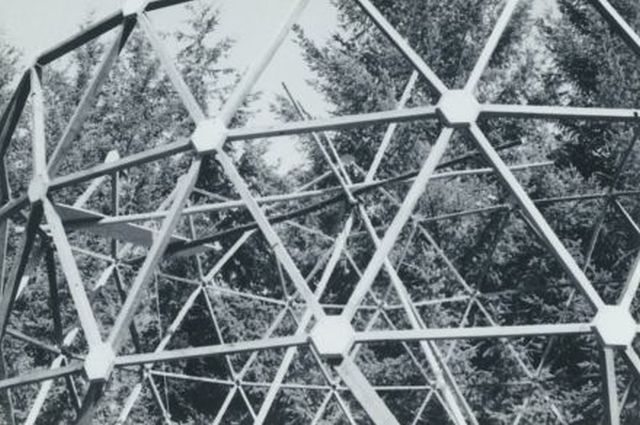
At one point in the evolution of Cold Comfort Farm the commune members decided to build a geodesic dome. We were then faced with the challenge of finding the materials. The word went out via the invisible network that connected the devotees of the “buy nothing” ethic. The power of a community to “manifest” whatever was needed had proved miraculous in the experience of back-to-the-landers everywhere. The fact that we were seeking material for a geodesic dome clearly helped stimulate and activate that network. What we needed for the frame was a bunch of 2×6s, the longer the better, thank you very much. We were willing to pay a modest amount but, of course, our preferred price was zero.
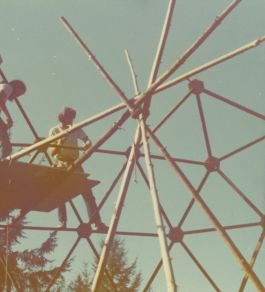
It couldn’t have been more than a week or two before we heard a rumor that a friend of a friend who was somebody’s sister-in-law had just inherited an old motel that needed to be demolished to make room for a new house. Would we be willing to do some of the tear-down and haul-away in exchange for forty sixteen-footers? Consensus of the commune was quickly reached. Our answer was “You bet!”
It wasn’t a simple project. We did have an old, battered Chevy pickup with an eight-foot bed. That was a good start. If the tailgate was down and the boards were carefully stacked we reckoned we would be able to get them all in one load without having them slide off the back of the truck.
In preparation for our whirlwind assault we gathered up all the tools that might come in handy: hammers of all sizes; crowbars and wrecking bars; hacksaws and chainsaws; jigsaws and handsaws; even a supersized magnet for sweeping up all stray bent nails when the final cleanup happened.
The old motel was located about a hundred miles north of Olympia. We needed to get an early start to get through Seattle before the morning rush hour. Our first view of the place was shocking. What a dump! The windows were mostly broken, the roof was sagging like a geriatric horse, the roofing was torn and hanging loose in places. There was a neon “No vacancy” sign with broken glass tubing dangling down. After a brief conversation with the property owner—just to be sure we were destroying the right place—we grabbed our tools, climbed up on the roof and “let ’er rip.”
The roofing pulled up in large chunks that immediately became the beginning of the to-the-dump pile. The plywood underneath was badly rotted and obviously worthless; also going to the dump. The doors were so inoperable we had to use our biggest sledge hammer to smash them open. Once inside we were engulfed in a musty smelling explosion of mold and mildew. It was like a radioactive mushroom cloud.
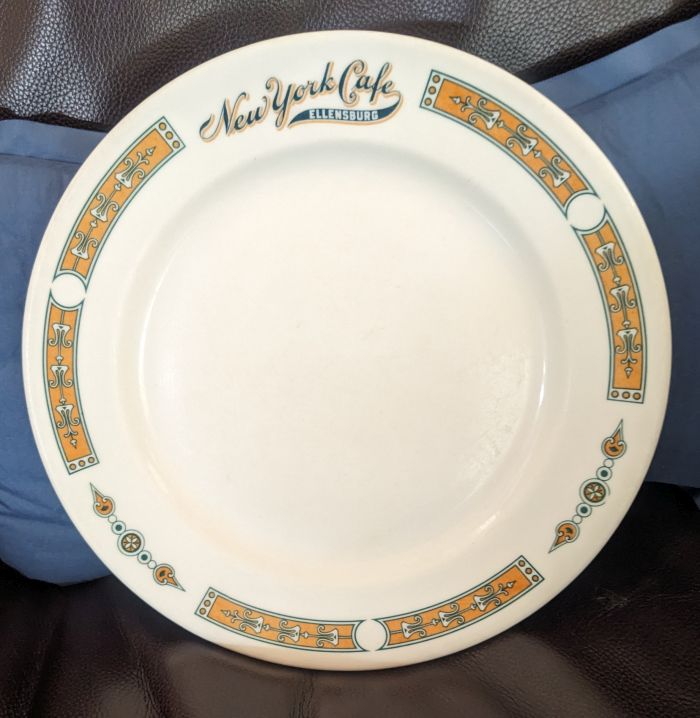
Donning masks and gloves, we ripped down the ceiling panels. And there they were: rafters of clear old-growth Douglas fir 2×6s, ours for the taking. After three or four hours of intense smashing and nail pulling, we stopped for a quick lunch of PB ’n’ J sandwiches that we had made the night before. Someone said, “My compliments to the chef. Nice and squishy, just the way I like them.” Some of us took the opportunity to poke around inside the rooms. Inside one of them we came upon a stack of cardboard boxes. They were heavy to lift and taped shut with silver duct tape. We cut the tape on the top box, and inside we found a complete set of beautiful pristine dinner plates. They were decorated with elegant Art Deco designs and bore the inscription, New York Cafe Ellensburg. A quick exploration revealed that there were dozens of the plates. In another box there were cups, saucers, and other restaurant-grade crockery, all similarly decorated.
We picked up a couple of the plates and took them to the owner, who had come down to see our progress and to bring us some hot coffee to go with our lunch. We asked, “What do you want us to do with these things? There are boxes of them. Where should we put them?”
“Oh,” she said, “you can take anything you want there. Everything that is left is just going to the dump.”
“Wow, thanks,” was all we could think to say. When we finished for the day, we had the pickup heavily loaded—down on the springs as the driver said. We tacked an old red t-shirt to the longest board. As we pulled out onto the highway we heard a kind of scraping sound, but nothing fell off, so we kept going. That scraping noise ended up being the soundtrack for our white-knuckle drive home.
We were all eager to get back to the farm and show off our load of lumber. But I was especially eager to have a meal on those beautiful plates. I’ve still got several. I’ll be happy to show you one the next time we get together.
We encourage readers to contact us with comments and corrections. Disclaimer